The Lung Cancer Channel is supported with funding from Johnson & Johnson (Gold).
VJOncology is an independent medical education platform. Supporters, including channel supporters, have no influence over the production of content. The levels of sponsorship listed are reflective of the amount of funding given to support the channel.
WCLC 2025 | Improving global radiotherapy access with the Rays of Hope initiative
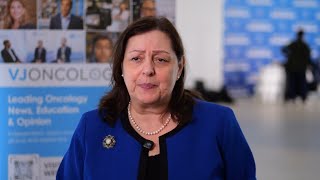
May Abdel-Wahab, MD, PhD, International Atomic Energy Agency, Vienna, Austria, comments on the Rays of Hope initiative, a collaborative effort to address the global shortage of radiation oncology professionals. The initiative focuses on developing radiotherapy and diagnostic imaging facilities, training professionals through fellowships, and establishing regional centers of excellence that provide support and harmonized curricula. This interview took place at 2025 World Conference on Lung Cancer (WCLC) in Barcelona, Spain.
These works are owned by Magdalen Medical Publishing (MMP) and are protected by copyright laws and treaties around the world. All rights are reserved.
Transcript
There are many different initiatives that are ongoing and one of the biggest is the Rays of Hope initiative that is led by the IAEA but we have many partners including many of the professional groups around the world and basically it includes three main pillars. The first pillar is we help countries develop radiotherapy and diagnostic imaging facilities and train people both long-term training, let’s say fellowships that mint radiation oncologists, radiation technologists, medical physicists, radiologists, and nuclear medicine physicians from scratch, or short-term fellowships where we actually can train people to become specialists in, subspecialists in certain things like radiosurgery or other types of subspecialties...
There are many different initiatives that are ongoing and one of the biggest is the Rays of Hope initiative that is led by the IAEA but we have many partners including many of the professional groups around the world and basically it includes three main pillars. The first pillar is we help countries develop radiotherapy and diagnostic imaging facilities and train people both long-term training, let’s say fellowships that mint radiation oncologists, radiation technologists, medical physicists, radiologists, and nuclear medicine physicians from scratch, or short-term fellowships where we actually can train people to become specialists in, subspecialists in certain things like radiosurgery or other types of subspecialties. The second pillar of Rays of Hope is basically a very important and essential part. And basically it covers the ability to have regional centers of excellence that actually provide support to the whole region. We found that having strong partners within the region helps alleviate some of the challenges that we have in terms of training and quality assurance, expertise and so forth. So what we’re trying to do is we’re trying to have these centers of excellence. We have 12 now. And in our next general conference, we will have an additional seven more. And we support them as in the whole process. We try to harmonize curricula around the world. So let’s say the most recent is a partnership with St. Jude’s and ourselves and all the other centers to try to have a harmonized curriculum for pediatric radiation oncology, for example. The same thing for gynecological radiation oncology, and including having the use of new technologies like virtual reality and so forth to enhance the learning experience. We know that we need 84,000 extra radiation oncologists, 141,000 extra radiation therapists, and a similar large number of medical physicists. And how are we going to achieve that unless we work together?
This transcript is AI-generated. While we strive for accuracy, please verify this copy with the video.
Read more...