The Lung Cancer Channel is supported with funding from Johnson & Johnson (Gold) and Takeda (Gold).
VJOncology is an independent medical education platform. Supporters, including channel supporters, have no influence over the production of content. The levels of sponsorship listed are reflective of the amount of funding given to support the channel.
BTOG 2026 | Robotic bronchoscopy improves diagnosis of indeterminate lung nodules
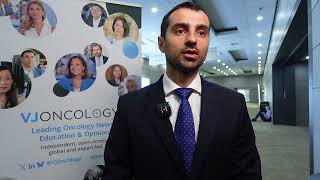
Ricky Thakrar, MBBS, MRCP, PhD, University College London, London, UK, provides an overview of advancements in interventional bronchoscopy, particularly the introduction of robotic-assisted bronchoscopy, which enables the targeting of lung nodules that were previously difficult to biopsy. Trials such as the CONFIRM trial (NCT05562895) have shown that these novel modalities can provide a tissue diagnosis for indeterminate lung nodules, potentially allowing for earlier treatment and preventing stage shift. This interview took place at the 2026 British Thoracic Oncology Group (BTOG) congress in Edinburgh, UK.
These works are owned by Magdalen Medical Publishing (MMP) and are protected by copyright laws and treaties around the world. All rights are reserved.
Transcript
The real change in interventional bronchoscopy has been the introduction of robotic-assisted bronchoscopy. So this is a robotic platform with a robotic catheter that is small in diameter, a stable platform that we can use to navigate through the airways and target lung nodules that we would have previously not really been able to biopsy. And there are some seminal trials and studies that have recently come out...
The real change in interventional bronchoscopy has been the introduction of robotic-assisted bronchoscopy. So this is a robotic platform with a robotic catheter that is small in diameter, a stable platform that we can use to navigate through the airways and target lung nodules that we would have previously not really been able to biopsy. And there are some seminal trials and studies that have recently come out. So there has been the CONFIRM study, which has recently been published in Thorax, which combines robotic technology with an image-guided system, cone beam CT, that during the procedure we can use to accurately target nodules. This is incredibly important. So when lung cancer screening was introduced, it’s also generated a lot of extra patients with lung nodules, indeterminate lung nodules. We’re not absolutely certain whether they may have cancer or not. And of course, we want a tissue diagnosis prior to treatment. And this is where a technology like robotic bronchoscopy comes into its own. One of the things that we’ve seen in a screening trial at University College London Hospital in the SUMMIT lung cancer screening trial is that patients can upstage while they’re waiting for treatment and so potentially for the smallest of nodules if we can get in there early with a biopsy we could potentially treat them earlier and possibly prevent that stage shift.
This transcript is AI-generated. While we strive for accuracy, please verify this copy with the video.
Read more...