The Lung Cancer Channel is supported with funding from Johnson & Johnson (Gold) and Takeda (Gold).
VJOncology is an independent medical education platform. Supporters, including channel supporters, have no influence over the production of content. The levels of sponsorship listed are reflective of the amount of funding given to support the channel.
WCLC 2025 | Evaluating the future role of tegavivint and osimertinib in EGFRm NSCLC
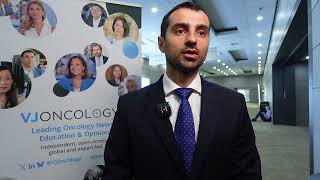
Regan Memmott, MD, PhD, The Ohio State University Comprehensive Cancer Center, Columbus, OH, highlights the potential of tegavivint as a treatment for EGFR-mutated non-small cell lung cancer (NSCLC), highlighting its ability to target cells that are not sensitive to chemotherapy. Tegavivint could be effective as a single agent or in combination with osimertinib, targeting cells that are not eliminated by chemotherapy. This interview took place at 2025 World Conference on Lung Cancer (WCLC) in Barcelona, Spain.
These works are owned by Magdalen Medical Publishing (MMP) and are protected by copyright laws and treaties around the world. All rights are reserved.
Transcript
I think the tegavivint, because it’s being so well tolerated, it has, you know, it could fit into whether you’re doing osimertinib as a single agent or the osimertinib with the chemotherapy. And I think from a scientific perspective, you know, it would target cells that the chemo is not. So these persisting cells, we see that they’re laying there dormantly in the tumor, slowly cycling and those slow cycling cells are not going to be sensitive to chemotherapy...
I think the tegavivint, because it’s being so well tolerated, it has, you know, it could fit into whether you’re doing osimertinib as a single agent or the osimertinib with the chemotherapy. And I think from a scientific perspective, you know, it would target cells that the chemo is not. So these persisting cells, we see that they’re laying there dormantly in the tumor, slowly cycling and those slow cycling cells are not going to be sensitive to chemotherapy. Chemo requires cells to be going through their cell cycle, right? So I think that the tegavivint is going to target these residual cells that the chemo is not getting that are persisting in response to the EGFR TKI.
This transcript is AI-generated. While we strive for accuracy, please verify this copy with the video.
Read more...