The Lung Cancer Channel is supported with funding from Johnson & Johnson (Gold).
VJOncology is an independent medical education platform. Supporters, including channel supporters, have no influence over the production of content. The levels of sponsorship listed are reflective of the amount of funding given to support the channel.
BTOG 2026 | Focusing on never-smoker patients with lung cancer at BTOG 2026
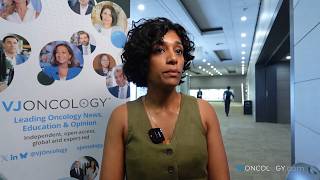
Sindhu Naidu, MBBS, University College London, London, UK, comments on the increasing research focus on never-smokers at the 2026 British Thoracic Oncology Group (BTOG) congress. Never-smokers have distinct experiences and support needs compared to smokers, and despite often being diagnosed at a later stage, they tend to have better outcomes, making survivorship in this group an interesting area of study. This interview took place at the 2026 BTOG congress in Edinburgh, UK.
These works are owned by Magdalen Medical Publishing (MMP) and are protected by copyright laws and treaties around the world. All rights are reserved.
Transcript
Yeah, so this is really early data. We’ve seen that there are some inequities in terms of early diagnosis and outcomes. I think the next question is to really think about why this is happening. The next stage of my research is I’d like to be looking at genomic drivers. So things like targetable mutations, things like EGFR, ALK, we know are more common in people who have never smoked...
Yeah, so this is really early data. We’ve seen that there are some inequities in terms of early diagnosis and outcomes. I think the next question is to really think about why this is happening. The next stage of my research is I’d like to be looking at genomic drivers. So things like targetable mutations, things like EGFR, ALK, we know are more common in people who have never smoked. And perhaps, for example, when we look at ethnicity, maybe this is the reason that that’s driving the better survival amongst people from Asian, Black, and other ethnicities. So I think improving access to genomic testing and ensuring that everyone gets genomic testing is really, really important. That’s just one of the sort of things that we need to work out as well. And I think when we talk about early diagnosis, I think the understanding that everyone with lungs can get lung cancer, whether or not you have smoked or never smoked.
This transcript is AI-generated. While we strive for accuracy, please verify this copy with the video.
Read more...