The Lung Cancer Channel is supported with funding from Johnson & Johnson (Gold).
VJOncology is an independent medical education platform. Supporters, including channel supporters, have no influence over the production of content. The levels of sponsorship listed are reflective of the amount of funding given to support the channel.
WCLC 2025 | Risks and considerations in managing NSCLC in pregnant patients
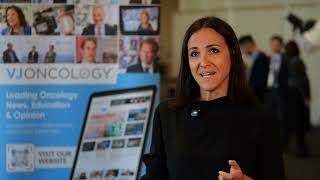
Martina Imbimbo, MD, Ente Ospedaliero Cantonale, Lugano, Switzerland, comments on the challenges of treating pregnant women with lung cancer, particularly those on tyrosine kinase inhibitors (TKIs). Respecting patient autonomy and multidisciplinary teams are important in supporting clinicians and patients. Global consortiums also play a role in collecting data and providing evidence to guide treatment decisions. This interview took place at 2025 World Conference on Lung Cancer (WCLC) in Barcelona, Spain.
These works are owned by Magdalen Medical Publishing (MMP) and are protected by copyright laws and treaties around the world. All rights are reserved.
Transcript
So this is a very nice topic. It’s a new one man needs because the prognosis of our patients, oncogene addicted patients, is completely changed since the introduction of new drugs. And we are facing more and more the issue of women with pregnancy who get a diagnosis of lung cancer, but also patients with lung cancer who are on treatment and they ask if they can get pregnant despite the diagnosis of lung cancer...
So this is a very nice topic. It’s a new one man needs because the prognosis of our patients, oncogene addicted patients, is completely changed since the introduction of new drugs. And we are facing more and more the issue of women with pregnancy who get a diagnosis of lung cancer, but also patients with lung cancer who are on treatment and they ask if they can get pregnant despite the diagnosis of lung cancer. So this is a tough question because, of course, there is no research in this field because it’s unethical, you know, to do TKIs on a pregnant woman. So for us, the physician, it is very hard. What we are trying to do is to collect all the data because we have used it, so I’ve used for the first time alectinib on a pregnant woman, and we’re using it, but we don’t know what the risks are. Some cases are going well, so what we are doing is creating a global consortium with not just Dr Flores from Dana-Farber, Professor Cadranel from Tenon Hospital in Paris, and Marina Garassino, Fedro Peccatori, it’s a very big consortium, and we’re trying to collect all the cases that have been treated in the world in order to try to really understand what is the feasibility and to give, you know, some more evidence to our patients and to the clinicians. But it’s very important when we have this discussion, you know, to always respect the patient’s autonomy to see what they want to do, to show the data, to show the lack of data that we have, and of course, this is a tough one. So it’s very important to have an obstetrical team that is with you, and as a consortium, we are always happy to help our clinicians, so they can just write an email or there is the INSEP, which is a cancer in pregnancy association to which I belong, that can help clinicians and patients.
This transcript is AI-generated. While we strive for accuracy, please verify this copy with the video.
Read more...