The Lung Cancer Channel is supported with funding from Johnson & Johnson (Gold) and Takeda (Gold).
VJOncology is an independent medical education platform. Supporters, including channel supporters, have no influence over the production of content. The levels of sponsorship listed are reflective of the amount of funding given to support the channel.
ASCO 2026 | What are the current unmet needs in second-line metastatic NSCLC?
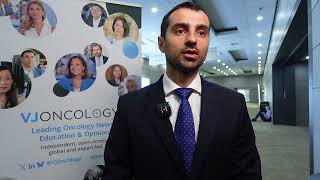
Abdul Rafeh Naqash, MD, University of Oklahoma Health Sciences Center, Oklahoma City, OK, discusses the need for better treatment options in the second-line setting for metastatic advanced non-small cell lung cancer (NSCLC). Multiple agents such as ivonescimab, antibody drug conjugates and bispecifics are currently being assessed and ongoing research into minimal residual disease (MRD) is underway in lung cancer to determine which patients may require adjuvant therapy. This interview took place during the 2026 American Society of Clinical Oncology (ASCO) Meeting in Chicago, IL.
These works are owned by Magdalen Medical Publishing (MMP) and are protected by copyright laws and treaties around the world. All rights are reserved.
Transcript
I think we’re importantly in the second-line setting for metastatic advanced non-small cell lung cancer. We need to find better options. The current standard of care still continues to remain docetaxel with or without ramucirumab. And I think we need to understand disease biology better. We need to understand resistance markers better to see what would be a good treatment option, whether it’s by specifics or antibody drug conjugates in the second-line and beyond setting for driver-negative metastatic non-small cell lung cancer...
I think we’re importantly in the second-line setting for metastatic advanced non-small cell lung cancer. We need to find better options. The current standard of care still continues to remain docetaxel with or without ramucirumab. And I think we need to understand disease biology better. We need to understand resistance markers better to see what would be a good treatment option, whether it’s by specifics or antibody drug conjugates in the second-line and beyond setting for driver-negative metastatic non-small cell lung cancer. So there is some data being presented. Obviously, the metastatic data for ivonescimab is being presented at this meeting, which will be very interesting to see. But more importantly, there are some other trials that are reporting on ADCs as well as other combinations in the metastatic advanced non-small cell lung cancer setting. As far as small cell lung cancer, last year we saw a lot of development as far as ADCs, bispecifics, tri-specifics are concerned for small cell. And I think now the tendency is to explore combinations of ADCs and bispecifics, as well as ADCs and chemotherapy in the second-line and beyond setting. And I think some of the trials to watch out for in that context are trials that are looking at maintenance of antibody drug conjugates or bispecifics in early-stage small cell lung cancer. So those are some of the studies that will likely transform the field in the next few years. And then a lot of work that is being done around MRD in terms of lung cancer, both in driver mutation positives, such as EGFR, as well as early-stage lung cancer. We’re trying to understand which patients need adjuvant therapy, especially if they’re MRD negative or have achieved pathological complete response, if those patients, in fact, need any kind of adjuvant therapy. So there’s some cooperative group trials that are looking at some of those concepts and will likely lead to more interesting results coming out in the subsequent meetings, including at ASCO.
This transcript is AI-generated. While we strive for accuracy, please verify this copy with the video.
Read more...