The Lung Cancer Channel is supported with funding from Johnson & Johnson (Gold) and Takeda (Gold).
VJOncology is an independent medical education platform. Supporters, including channel supporters, have no influence over the production of content. The levels of sponsorship listed are reflective of the amount of funding given to support the channel.
ESMO Asia 2025 | Increasing eligibility for surgery with neoadjuvant therapy in lung cancer
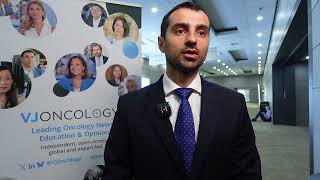
Jazmin Eckhaus, MBBS, FRACS, St Vincent’s Hospital, Melbourne, Australia, comments on the impact of neoadjuvant therapy on the treatment of lung cancer, highlighting its potential to expand operability and resectability in patients with advanced stage cancers. Neoadjuvant therapy has enabled clinicians to consider surgery for patients who would previously have been deemed inoperable, such as those with N2 disease. This interview took place at 2025 European Society for Medical Oncology (ESMO) Asia Congress in Singapore, Singapore.
These works are owned by Magdalen Medical Publishing (MMP) and are protected by copyright laws and treaties around the world. All rights are reserved.
Transcript
So neoadjuvant has been one of the most exciting changes for our patients with lung cancer, I think. And at least in my setting, what we’ve done is I’ve taken patients who I would never have considered operating on, people with more advanced stage cancers, and now what we’re suggesting is they have neoadjuvant and then they come forward for operations...
So neoadjuvant has been one of the most exciting changes for our patients with lung cancer, I think. And at least in my setting, what we’ve done is I’ve taken patients who I would never have considered operating on, people with more advanced stage cancers, and now what we’re suggesting is they have neoadjuvant and then they come forward for operations. For me, this hasn’t changed who has adjuvant therapy as the indications for that haven’t changed. And so there’s still going to be a mixed pool of patients, those who have surgery and then are offered adjuvant and those patients who are offered the sandwich strategy and have neoadjuvant therapy and then surgery and then adjuvant. In terms of operability and resectability, certainly that we’ve really pushed that out. So before I would have said any patient with, except in very unusual circumstances, who had N2 disease was definitely not suitable for surgery. And now that just becomes part of the discussion around neoadjuvant care.
This transcript is AI-generated. While we strive for accuracy, please verify this copy with the video.
Read more...