The Lung Cancer Channel is supported with funding from Johnson & Johnson (Gold) and Takeda (Gold).
VJOncology is an independent medical education platform. Supporters, including channel supporters, have no influence over the production of content. The levels of sponsorship listed are reflective of the amount of funding given to support the channel.
WCLC 2025 | Real-world outcomes of IO intensification in advanced NSCLC
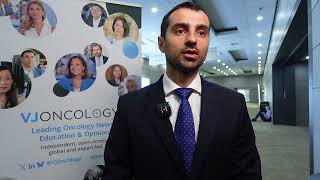
Xiao Wang, MD, Yale Cancer Center, New Haven, CT, discusses real-world outcomes of first-line immunotherapy intensification strategies for patients with advanced non-small cell lung cancer (NSCLC). Outcomes of single immune checkpoint inhibitor plus chemotherapy, dual immune checkpoint inhibitor plus chemotherapy, and dual immune checkpoint inhibitor regimens were compared. Results indicated no additional clinical benefit with intensified regimens, including in patients with STK11/KEAP1 alterations, highlighting the need for prospective studies to refine treatment selection. This interview took place at 2025 World Conference on Lung Cancer (WCLC) in Barcelona, Spain.
These works are owned by Magdalen Medical Publishing (MMP) and are protected by copyright laws and treaties around the world. All rights are reserved.
Transcript
As we all know, there are multiple IO-based regimens for the first-line treatment of advanced non-small cell lung cancer. And there’s a lot of clinical equipoise about who may benefit from IO intensification with dual checkpoint blockade. And there’s been a lot of interest in biomarkers that may predict benefit from that intensification, such as KEAP1 or STK11...
As we all know, there are multiple IO-based regimens for the first-line treatment of advanced non-small cell lung cancer. And there’s a lot of clinical equipoise about who may benefit from IO intensification with dual checkpoint blockade. And there’s been a lot of interest in biomarkers that may predict benefit from that intensification, such as KEAP1 or STK11. And so the motivation behind our study was to take a look at whether intensification improves outcomes in real-world populations and specifically in populations with those high-risk alterations in their cancers. So our findings were that, much to our surprise, intensification did not benefit the overall population and did not benefit specifically those patients with high-risk cancers. And so that was a surprise to us because we felt like, you know, we had a good preclinical hypothesis. There’s been a lot of subgroup analyses of the Poseidon trial looking at that. And so I think what it shows us is that there may be a difference between clinical trial populations and the general lung cancer population at large. You know, I don’t think it’s a surprise to say that the general population tends to be sicker, more frail, have more comorbidities. And because of that, is the benefit that folks are getting from dual checkpoint blockade being outweighed by the toxicity that they’re experiencing as well, especially in non-clinical trial populations.
This transcript is AI-generated. While we strive for accuracy, please verify this copy with the video.
Read more...